The Last Mile Problem

The Last Mile Problem

Why Brilliant Research Misses Policy—and How to Fix It

Daniel Haight

Nov 5, 2025
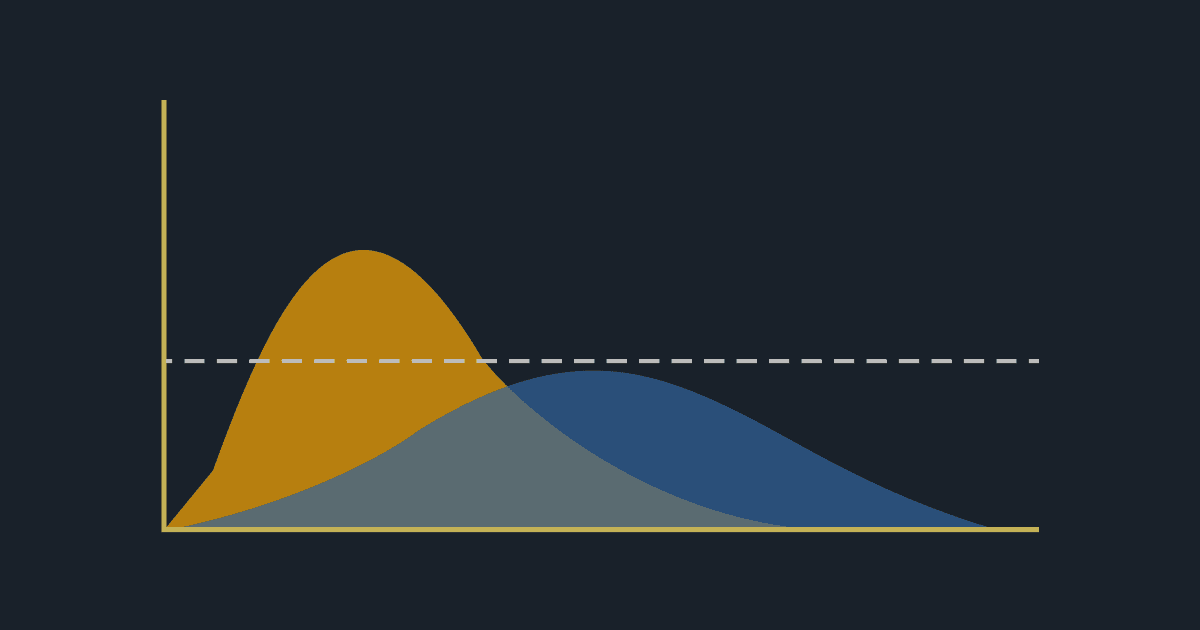
In March 2020, a single graphic changed the world. Not a peer-reviewed paper. Not a 40-page report. A two-line chart labeled "Flatten the Curve."

It reached governors and mayors and school boards and individual families, all making different decisions from the same image. It convinced public health hawks and economic doves simultaneously. It took exponential growth (a concept that defies intuition) and made it obvious.

This was data visualization doing what it's designed to do: distilling complexity and inspiring action. If you're still relying on PDFs and press releases, you're trying to ship a grand piano through a mail slot.

The Diagnosis

Brilliant research. Years of work. Millions in funding. Peer-reviewed publication. And then... crickets.

You did everything right. The research is sound. The findings matter. But somewhere between your data and the decisions it should inform, the delivery fails.

Rigorous research is half the battle. Communication is the other half.

The gap takes three forms:

Complexity - Your package is too big for the truck Alignment - Your recipient is suspicious of what's inside Segmentation - You're trying to deliver to a hundred different addresses

Problem 1: The Package Won't Fit

You have 70,000 census tracts of data. Or 184 environmental indicators across decades. Your methodology was your PhD thesis. The complexity is what makes your research rigorous. It's why you spent three years instead of three months. Your package of insights is huge.

Sadly, the policymaker has 30 seconds before the next meeting. The journalist has 300 words. The community advocate is on mobile in a church basement with spotty wifi.

So you make static charts, write an executive summary, put a TL;DR on the exec summary*. Maybe you even record one of your talks on Youtube. These all help, but they're not enough.

The problem? Your audience still can't lift your package. Your static chart has made one insight accessible, but that only works for one policy or one story. You haven’t sent the package, you’ve sent a sample.

What visualization does:

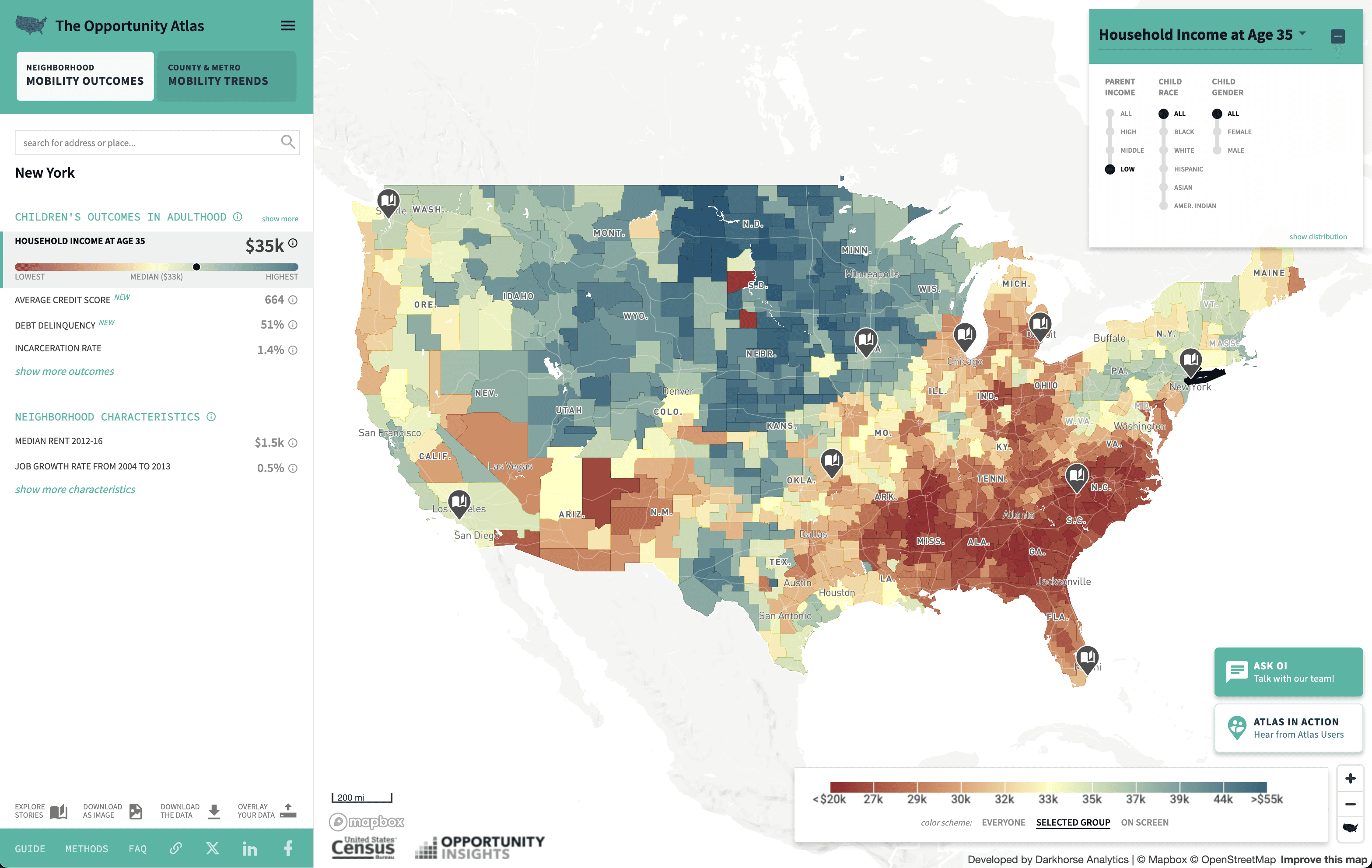
Harvard's Raj Chetty mapped economic mobility for every neighborhood in America.[1] 800 million data combinations from decades of IRS records. The Opportunity Atlas starts you out in your own neighborhood and lets you see mobility outcomes. Want to know why these neighborhoods differ? Drill down. Want to compare to similar areas? Switch views. Want to validate methodology? It's there for the PhD who needs it.

Same data, different loads for different carriers. The journalist finds the surprising neighborhood. The policymaker gets district summaries. The PhD examines methods. The community organizer prints maps for city council.

This isn't dumbing down. It's rightsizing the delivery.

Problem 2: They Don't Trust the Sender

Your audience understands your claim. They just don't believe you.

Maybe they're ideologically opposed. Maybe they've been burned by "research" that turned out to be tobacco industry propaganda. Maybe they don't trust academics generally. (Can you blame them? Eggs went from staple to poison to superfood in a single generation.)

You got the right answer. Now you need to convince people.

More evidence won't work. Stronger methods sections just look like you're trying harder to sell them something. You can't convince them without showing your work, but showing more work looks suspicious.

What visualization does:

When EDF set out to channel massive federal climate investments into the communities that needed them most, one question loomed: “Which areas have the greatest need for Justice 40 funding?”

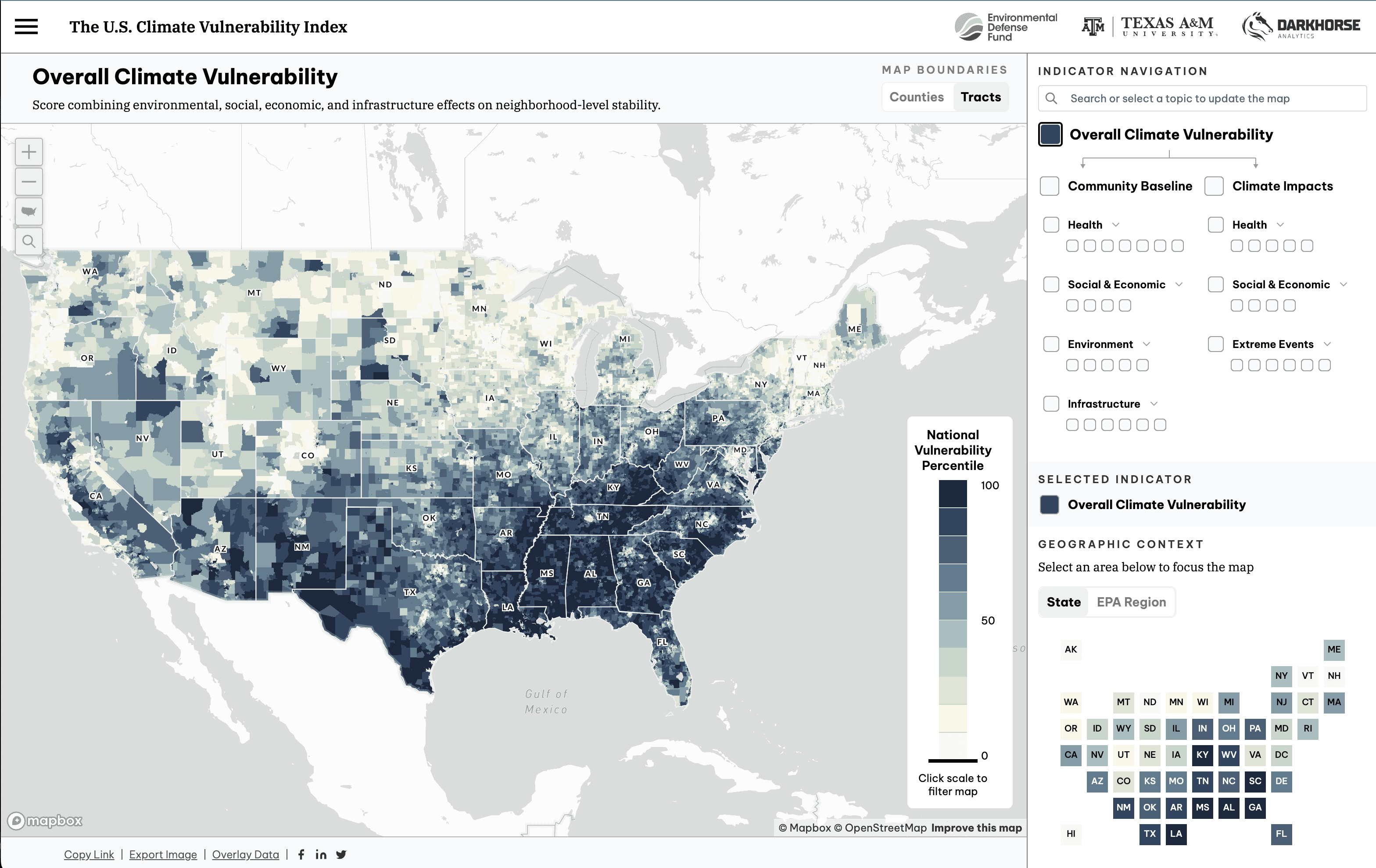
Rather than deliver another dense technical memo explaining dozens of vulnerability components, they built the Climate Vulnerability Index.[2]

Click in. Explore 184 indicators across more than 70,000 U.S. census tracts. See which factors drive a neighborhood’s vulnerability—housing quality, flood risk, proximity to pollution, access to healthcare. Flip individual layers on or off. Test your assumptions. 

This isn’t research crammed into a PDF. It’s transparency designed for interrogation. People are more convinced by what they discover than by what they’re told. And the result? The tool became infrastructure—used by congressional staffers to shape federal guidelines. Not because EDF had more clout, but because giving someone a tool is more persuasive than ten thousand eloquent words.

Problem 3: A Hundred Different Destinations

Wayne State University had hundreds of health metrics for each census tract in Michigan.4 They'd tried dashboards (too complicated), infographics (too simplified), and reports (nobody read them). Different audiences kept needing different things from the same data. [3]

Epidemiologists wanted methodological detail and full datasets. Community health practitioners needed printable neighborhood maps. Congressional staffers required district summaries. Journalists hunted for compelling outliers. Foundation officers looked for coverage gaps.

The usual solution? Write different reports for different audiences. Or write one report aimed at a middle level that satisfies nobody. It's like addressing a package to "whoever needs this information."

Wayne State built the Phoenix Health Dashboard with a different premise: one tool, multiple entry points.

Epidemiologists validate methodology and download datasets. Community health practitioners search by address and print maps. Journalists filter for outcomes and pull charts. Policymakers view district summaries. Foundation officers identify high-need areas.

Not five different tools requiring five maintenance schedules. One data infrastructure with different doors. This required serious technical architecture, not just design polish. When your tool crashes on mobile or takes 30 seconds to load, it will soon be abandoned.

The PI called it "probably the best decision I made professionally in the last few years." Not because it was pretty. Because after a decade generating insights, those insights finally reached people who could act on them.

The Uncomfortable Truth

PDFs and press releases were designed for a world where people read 40-page reports and policy moved on 18-month cycles. [†]

That world left without saying goodbye.

You spent years on rigorous research. Millions in funding. Careful methodology. And it's sitting on a shelf while less rigorous but better communicated work shapes the policy you should be influencing.

This isn't about dumbing down. It's about physics. Ten thousand research studies are published daily. Maybe a hundred policy decisions get made. The bottleneck isn't evidence. It's evidence that can be carried from your desk to someone's decision.

When the pandemic hit and every hour counted, we didn't reach for peer-reviewed papers. We reached for visualization. [4]

What to Do

The organizations whose work moves policy figured this out: plan visualization when you write the grant proposal, not when the paper gets accepted. Budget 10-15% of research costs for communication. Commit to multi-year evolution, not one-off deliverables.

Most institutions want congressional testimony without the maintenance plan. Impact without investment. Then they wonder why their findings gather dust while flashier work shapes billion-dollar budgets.

Start by diagnosing which problem is killing your impact. Is your package too big? Are your recipients suspicious? Are you trying to deliver to a hundred addresses?

Then budget accordingly. If you're spending $2M on research, spend $200K ensuring it reaches people who can act on it. Your funder already required a dissemination plan. This is how you execute it.

Delivery isn't a detail. It's where research lives or dies.

References

[*]: We actually timed this. The average "executive summary" takes 12-18 minutes to read carefully. Which explains why executives don't read them.

[†]: The PDF format was invented in 1993, the same year as the Pentium processor and Beanie Babies. Two of these three things are still considered cutting-edge technology for research dissemination.

[1]: Chetty, R., Friedman, J., Hendren, N., Jones, M., & Porter, S. (2018). The Opportunity Atlas: Mapping the Childhood Roots of Social Mobility. National Bureau of Economic Research. 

[2]: Environmental Defense Fund. (2022). Climate Vulnerability Index. https://climatevulnerabilityindex.org/

[3]: Wayne State University. (2021). Phoenix Health Dashboard. https://phoenix-data.wayne.edu/

[4]: Harris, R. (2020). "How 'Flatten the Curve' Changed the Course of the Pandemic." NPR. https://www.npr.org/sections/health-shots/2020/03/13/815502262/flattening-a-pandemics-curve-why-staying-home-now-can-save-lives

In March 2020, a single graphic changed the world. Not a peer-reviewed paper. Not a 40-page report. A two-line chart labeled "Flatten the Curve."

It reached governors and mayors and school boards and individual families, all making different decisions from the same image. It convinced public health hawks and economic doves simultaneously. It took exponential growth (a concept that defies intuition) and made it obvious.

This was data visualization doing what it's designed to do: distilling complexity and inspiring action. If you're still relying on PDFs and press releases, you're trying to ship a grand piano through a mail slot.

The Diagnosis

Brilliant research. Years of work. Millions in funding. Peer-reviewed publication. And then... crickets.

You did everything right. The research is sound. The findings matter. But somewhere between your data and the decisions it should inform, the delivery fails.

Rigorous research is half the battle. Communication is the other half.

The gap takes three forms:

Complexity - Your package is too big for the truck Alignment - Your recipient is suspicious of what's inside Segmentation - You're trying to deliver to a hundred different addresses

Problem 1: The Package Won't Fit

You have 70,000 census tracts of data. Or 184 environmental indicators across decades. Your methodology was your PhD thesis. The complexity is what makes your research rigorous. It's why you spent three years instead of three months. Your package of insights is huge.

Sadly, the policymaker has 30 seconds before the next meeting. The journalist has 300 words. The community advocate is on mobile in a church basement with spotty wifi.

So you make static charts, write an executive summary, put a TL;DR on the exec summary*. Maybe you even record one of your talks on Youtube. These all help, but they're not enough.

The problem? Your audience still can't lift your package. Your static chart has made one insight accessible, but that only works for one policy or one story. You haven’t sent the package, you’ve sent a sample.

What visualization does:

Harvard's Raj Chetty mapped economic mobility for every neighborhood in America.[1] 800 million data combinations from decades of IRS records. The Opportunity Atlas starts you out in your own neighborhood and lets you see mobility outcomes. Want to know why these neighborhoods differ? Drill down. Want to compare to similar areas? Switch views. Want to validate methodology? It's there for the PhD who needs it.

Same data, different loads for different carriers. The journalist finds the surprising neighborhood. The policymaker gets district summaries. The PhD examines methods. The community organizer prints maps for city council.

This isn't dumbing down. It's rightsizing the delivery.

Problem 2: They Don't Trust the Sender

Your audience understands your claim. They just don't believe you.

Maybe they're ideologically opposed. Maybe they've been burned by "research" that turned out to be tobacco industry propaganda. Maybe they don't trust academics generally. (Can you blame them? Eggs went from staple to poison to superfood in a single generation.)

You got the right answer. Now you need to convince people.

More evidence won't work. Stronger methods sections just look like you're trying harder to sell them something. You can't convince them without showing your work, but showing more work looks suspicious.

What visualization does:

When EDF set out to channel massive federal climate investments into the communities that needed them most, one question loomed: “Which areas have the greatest need for Justice 40 funding?”

Rather than deliver another dense technical memo explaining dozens of vulnerability components, they built the Climate Vulnerability Index.[2]

Click in. Explore 184 indicators across more than 70,000 U.S. census tracts. See which factors drive a neighborhood’s vulnerability—housing quality, flood risk, proximity to pollution, access to healthcare. Flip individual layers on or off. Test your assumptions. 

This isn’t research crammed into a PDF. It’s transparency designed for interrogation. People are more convinced by what they discover than by what they’re told. And the result? The tool became infrastructure—used by congressional staffers to shape federal guidelines. Not because EDF had more clout, but because giving someone a tool is more persuasive than ten thousand eloquent words.

Problem 3: A Hundred Different Destinations

Wayne State University had hundreds of health metrics for each census tract in Michigan.4 They'd tried dashboards (too complicated), infographics (too simplified), and reports (nobody read them). Different audiences kept needing different things from the same data. [3]

Epidemiologists wanted methodological detail and full datasets. Community health practitioners needed printable neighborhood maps. Congressional staffers required district summaries. Journalists hunted for compelling outliers. Foundation officers looked for coverage gaps.

The usual solution? Write different reports for different audiences. Or write one report aimed at a middle level that satisfies nobody. It's like addressing a package to "whoever needs this information."

Wayne State built the Phoenix Health Dashboard with a different premise: one tool, multiple entry points.

Epidemiologists validate methodology and download datasets. Community health practitioners search by address and print maps. Journalists filter for outcomes and pull charts. Policymakers view district summaries. Foundation officers identify high-need areas.

Not five different tools requiring five maintenance schedules. One data infrastructure with different doors. This required serious technical architecture, not just design polish. When your tool crashes on mobile or takes 30 seconds to load, it will soon be abandoned.

The PI called it "probably the best decision I made professionally in the last few years." Not because it was pretty. Because after a decade generating insights, those insights finally reached people who could act on them.

The Uncomfortable Truth

PDFs and press releases were designed for a world where people read 40-page reports and policy moved on 18-month cycles. [†]

That world left without saying goodbye.

You spent years on rigorous research. Millions in funding. Careful methodology. And it's sitting on a shelf while less rigorous but better communicated work shapes the policy you should be influencing.

This isn't about dumbing down. It's about physics. Ten thousand research studies are published daily. Maybe a hundred policy decisions get made. The bottleneck isn't evidence. It's evidence that can be carried from your desk to someone's decision.

When the pandemic hit and every hour counted, we didn't reach for peer-reviewed papers. We reached for visualization. [4]

What to Do

The organizations whose work moves policy figured this out: plan visualization when you write the grant proposal, not when the paper gets accepted. Budget 10-15% of research costs for communication. Commit to multi-year evolution, not one-off deliverables.

Most institutions want congressional testimony without the maintenance plan. Impact without investment. Then they wonder why their findings gather dust while flashier work shapes billion-dollar budgets.

Start by diagnosing which problem is killing your impact. Is your package too big? Are your recipients suspicious? Are you trying to deliver to a hundred addresses?

Then budget accordingly. If you're spending $2M on research, spend $200K ensuring it reaches people who can act on it. Your funder already required a dissemination plan. This is how you execute it.

Delivery isn't a detail. It's where research lives or dies.

References

[*]: We actually timed this. The average "executive summary" takes 12-18 minutes to read carefully. Which explains why executives don't read them.

[†]: The PDF format was invented in 1993, the same year as the Pentium processor and Beanie Babies. Two of these three things are still considered cutting-edge technology for research dissemination.

[1]: Chetty, R., Friedman, J., Hendren, N., Jones, M., & Porter, S. (2018). The Opportunity Atlas: Mapping the Childhood Roots of Social Mobility. National Bureau of Economic Research. 

[2]: Environmental Defense Fund. (2022). Climate Vulnerability Index. https://climatevulnerabilityindex.org/

[3]: Wayne State University. (2021). Phoenix Health Dashboard. https://phoenix-data.wayne.edu/

[4]: Harris, R. (2020). "How 'Flatten the Curve' Changed the Course of the Pandemic." NPR. https://www.npr.org/sections/health-shots/2020/03/13/815502262/flattening-a-pandemics-curve-why-staying-home-now-can-save-lives

Related Solutions
LOVE DATA AS MUCH AS WE DO?

Join our readers who get design tips, visualization stories, and clarity straight from Darkhorse.

10139 81 Avenue NW
Edmonton, AB T6E 1W9
Canada

1-800-261-1832

Empower Your Research.


Amplify Your Insights.


Impact Your Mission.

© Darkhorse Visualization 2026 · All Rights Reserved

10139 81 Avenue NW
Edmonton, AB T6E 1W9
Canada

1-800-261-1832

Empower Your Research.


Amplify Your Insights.


Impact Your Mission.

© Darkhorse Visualization 2026 · All Rights Reserved

10139 81 Avenue NW
Edmonton, AB T6E 1W9
Canada

1-800-261-1832

Empower Your Research.


Amplify Your Insights.


Impact Your Mission.

© Darkhorse Visualization 2026 · All Rights Reserved

10139 81 Avenue NW
Edmonton, AB T6E 1W9
Canada

1-800-261-1832

Empower Your Research.


Amplify Your Insights.


Impact Your Mission.

© Darkhorse Visualization 2026 · All Rights Reserved