
When Small is More

When Small is More

Joey Cherdarchuk

Dec 22, 2014
We've done a few critique/redesigns of graphics on the site, but now its time to shine that sometimes unflattering light back on ourselves. While going through some materials I came across a graphic much like this one.

Vikings will be vikings


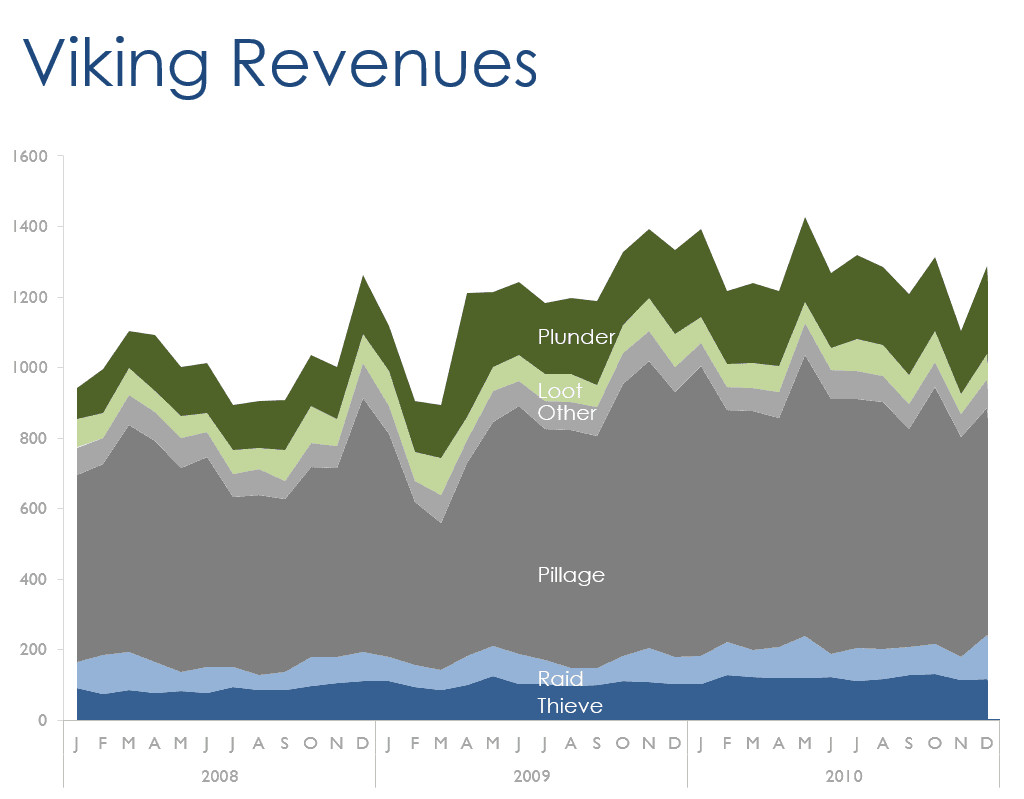
The chart is clean, with axes lightened so the data is in the foreground, and the series direct labelled. Unfortunately it is not very effective at conveying much beyond "There is lots of pillaging." If we look closely we may also see a slight upward trend in Thieving and in revenues overall, but insights beyond that are all obscured by our chart choice.

The problem with stacked charts is that only the first series, in this case Thieving, and the total of all series are clearly displayed. Everything else is distorted by the shifting baseline of the series beneath it. If you want to note patterns in the individual series, stacked charts are inadequate.

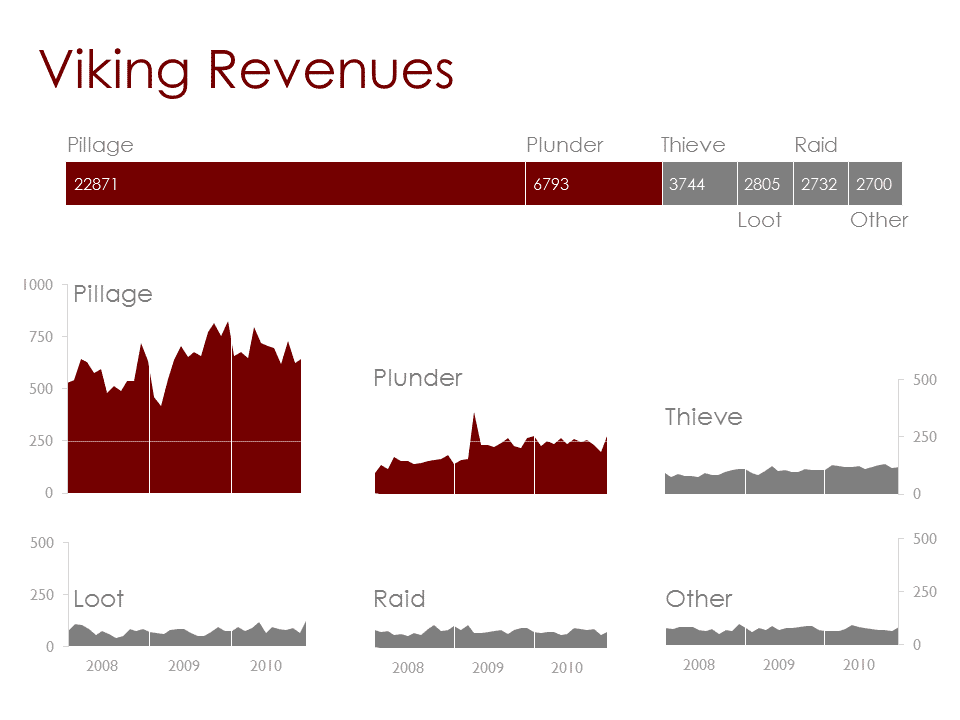
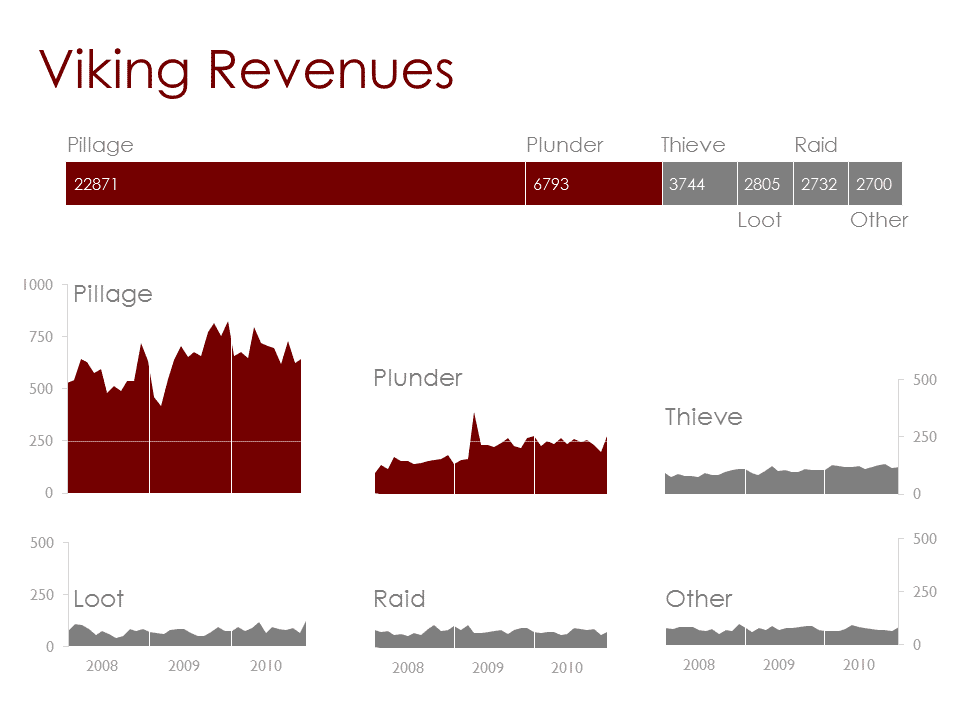
Don't be afraid of small things The solution in this case is to simply make a small chart for each series. Often called "small multiples" these charts reveal the patterns for each series and let us compare between the series. To give a sense of the proportions of the different series we can add another chart specifically for that purpose. What pops out now is a rather interesting change in Plundering which was previously hidden.

Vikings will be better vikings


Don't be afraid to make your charts smaller to communicate a bigger, more complete message.

We've done a few critique/redesigns of graphics on the site, but now its time to shine that sometimes unflattering light back on ourselves. While going through some materials I came across a graphic much like this one.


Vikings will be vikings


The chart is clean, with axes lightened so the data is in the foreground, and the series direct labelled. Unfortunately it is not very effective at conveying much beyond "There is lots of pillaging." If we look closely we may also see a slight upward trend in Thieving and in revenues overall, but insights beyond that are all obscured by our chart choice.

The problem with stacked charts is that only the first series, in this case Thieving, and the total of all series are clearly displayed. Everything else is distorted by the shifting baseline of the series beneath it. If you want to note patterns in the individual series, stacked charts are inadequate.

Don't be afraid of small things The solution in this case is to simply make a small chart for each series. Often called "small multiples" these charts reveal the patterns for each series and let us compare between the series. To give a sense of the proportions of the different series we can add another chart specifically for that purpose. What pops out now is a rather interesting change in Plundering which was previously hidden.


Vikings will be better vikings


Don't be afraid to make your charts smaller to communicate a bigger, more complete message.

LOVE DATA AS MUCH AS WE DO?

Join our readers who get design tips, visualization stories, and clarity straight from Darkhorse.

10139 81 Avenue NW
Edmonton, AB T6E 1W9
Canada

1-800-261-1832

Empower Your Research.


Amplify Your Insights.


Impact Your Mission.

© Darkhorse Visualization 2026 · All Rights Reserved

10139 81 Avenue NW
Edmonton, AB T6E 1W9
Canada

1-800-261-1832

Empower Your Research.


Amplify Your Insights.


Impact Your Mission.

© Darkhorse Visualization 2026 · All Rights Reserved

10139 81 Avenue NW
Edmonton, AB T6E 1W9
Canada

1-800-261-1832

Empower Your Research.


Amplify Your Insights.


Impact Your Mission.

© Darkhorse Visualization 2026 · All Rights Reserved

10139 81 Avenue NW
Edmonton, AB T6E 1W9
Canada

1-800-261-1832

Empower Your Research.


Amplify Your Insights.


Impact Your Mission.

© Darkhorse Visualization 2026 · All Rights Reserved